Don’t just read about it, experience it - you can play an online version of Cow Island Publishing’s Consul of Rome card game today by clicking here.
Give us a follow here, on the “Of Rome” games TikTok or Instagram and the Cow Island Publishing Instagram to stay up to date.
Introduction
This introduction is slightly out of date as I started writing it ages ago but I’m going to leave the tense in any event – imagine reading it as I developed these concepts.
With the main bones of the game completed (or rather a good fifth draft of the rules that I’m going to test with real people, not just machine models, in due course), I went in search of some additional mechanics that could expand the play and make it a bit more challenging.
When playing with my kids, there is virtually always a request for “one more go” and frankly it’s the same when I’m playing cards with adults. I still wanted to maintain a short/quick version and rather than significantly altered rules, just introduce some mechanics and a longer scoring mechanism.
This lead to two thoughts:
- Fixing the scoring mechanism and victory conditions for different game lengths.
- Adding catch up mechanics as sometimes in play-testing getting early additional Senators (10 votes versus a normal 1) felt a bit lopsided.
Scoring and new victory conditions
In a quick version, scoring and victory are straightforward – most votes when the first player has discarded all their cards wins.
For a longer “Campaign” mode, there needs to be a target number of rounds or a cumulative vote total to reach for. My own suggestion to players will be to go for a century – 100 votes wins. It’s got a nice ring to it and on average means about 3-5 rounds.
I feel like this gives a nice range of play times and then when I add the
In game catch up mechanics
First I settled on a theme for the catch up mechanics. Being set around Ancient Rome, there were two obvious routes:
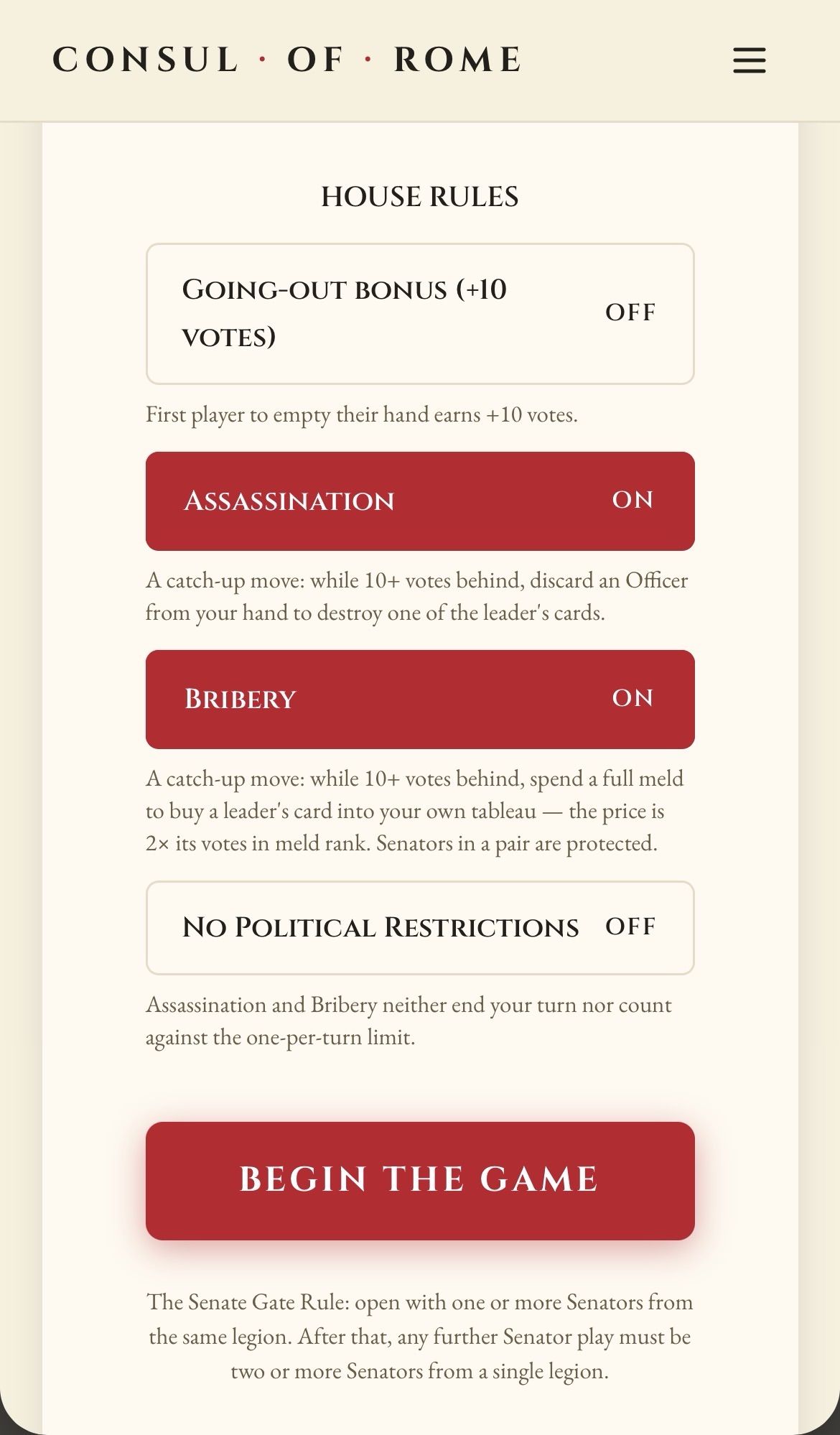
- Bribery: even the most honourable, so to speak, were prone to influence peddling through coin.
- Assassination: the history books show that being in public life was not exactly risk free. It was probably worse during the Empire, but still we remember the most famous Assasination to this day on the ides of March – the killing of Julius Caesar.
These felt apt, so then I worked out how it would work.

Bribery – influence through coin rather then strength
I had already planned something like this when I designed the cards, attributing each card a “rank” number that looks a bit like a coin.
How to make it work in a balanced way?
- First, I decided you could only use this mechanic if you were behind. Ten votes behind felt right as that would mean that the leader likely had an extra Senator.
- Second, you can’t keep on using the mechanic. You can only use it once per round (though if you want a bloody corrupt game, you can remove these restrictions).
- Third, the cost had to be real but not too much. I settled on it having to be a full meld that you discard (where the total rank numbers are greater than the votes being bribed. That is, a meld of at least 20 rank to bribe a senator)
- Fourth, bribery costs more so you get more – the senator actually comes over to your tableau.
Now, this is still evolving but k think it adds a great dimension to play.
Assasination – cut the leader down to size
Likewise, Assasination had to feel balanced but cheaper since it was an evener rather than a leap frog move. How to go about that?
- First, the cost. I played around with a few ideas but am currently on you having to discard an officer from your hand in return for taking a senator.
- Second, I thought about when you can play it. Once a round and when you’re behind felt right. Still deciding if you need the 10 vote gap.
Stay tuned for more!